Solid State Relay vs Mechanical Relay: Key Differences, Uses, and How to Choose
2026-05-07
4
Catalog
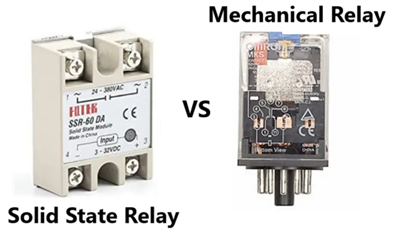
Figure 1. Solid State Relay vs Mechanical Relay
What Is a Solid State Relay (SSR)?
A solid state relay (SSR) is an electronic switch that turns a load ON or OFF without moving parts. SSR does not use metal contacts. Instead, it uses semiconductor devices such as TRIACs, MOSFETs, or transistors to control current. A basic SSR has an input circuit, an isolation section, and an output switching device. The input receives a small control signal, while the output controls the connected load. The isolation section helps protect the control side from high voltage and electrical noise. Since an SSR has no moving parts, it switches silently, responds quickly, and has less wear over time. SSR is used in heaters, temperature controllers, PLC systems, motor control, and industrial automation equipment.
What Is a Mechanical Relay (EMR)?
A mechanical relay, also called an electromechanical relay (EMR), is an electrical switch that uses an electromagnetic coil and physical metal contacts to control current flow. When power is applied to the coil, it creates a magnetic field that moves the internal contacts to open or close a circuit. EMR contains an electromagnetic coil, armature, spring, and metal contacts. The coil generates magnetic force, while the contacts physically connect or disconnect the electrical circuit. Mechanical relays work through physical switching. When the coil is energized, the contacts move into position and allow current to flow. When power is removed, the spring returns the contacts to their original state. EMRs are used in power supplies, automotive systems, industrial control panels, home appliances, motor control circuits, and older automation systems where simple and reliable switching is required.
Solid State Relay vs Mechanical Relay: Key Differences
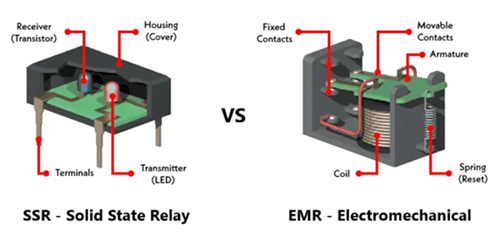
Figure 2. SSR vs EMR Relay Structure
|
Parameter |
Solid
State Relay (SSR) |
Mechanical
Relay (EMR) |
|
Switching Mechanism |
Uses semiconductor
devices like TRIACs, MOSFETs, or transistors |
Uses an
electromagnetic coil and physical metal contacts |
|
Switching Method |
Electronic switching |
Mechanical contact
switching |
|
Switching Speed |
Very fast switching |
Slower due to moving
parts |
|
Operational Life |
Longer lifespan
because there are no moving contacts |
Shorter lifespan
because contacts wear out over time |
|
Acoustic Noise |
Silent operation |
Produces clicking
sound during switching |
|
Heat Management |
Generates more heat
and may require a heat sink |
Produces less heat
during operation |
|
Power Use |
Lower control power
consumption |
Higher power required
for coil operation |
|
Electrical Isolation |
Uses optical or
electronic isolation |
Uses physical
separation between contacts and coil |
|
Initial Cost |
Usually more
expensive |
Usually lower cost |
SSR vs Mechanical Relay: Advantages and Limitations
Solid State Relay (SSR)
Advantages
• Silent operation since there are no moving parts
• Faster switching speed
• Longer operational life with less mechanical wear
• Resistant to vibration and shock
• Suitable for frequent switching applications
Limitations
• Generates heat during operation
• May require a heat sink for cooling
• Higher initial cost
• Small leakage current may exist even when OFF
Mechanical Relay (EMR)
Advantages
• Lower cost and widely available
• Simple and easy-to-use design
• Handle high surge current well
• Strong physical electrical isolation
• Usually generates less heat during operation
Limitations
• Slower switching speed
• Produces clicking noise during switching
• Physical contacts wear out over time
• Less suitable for very frequent switching
• Can be affected by vibration and mechanical wear
Relay Failure Modes: Fail Open vs Fail Closed
Relay failure usually happens in two main ways: fail open or fail closed. These failure modes affect whether the connected load turns OFF, stays ON, or stops responding correctly.
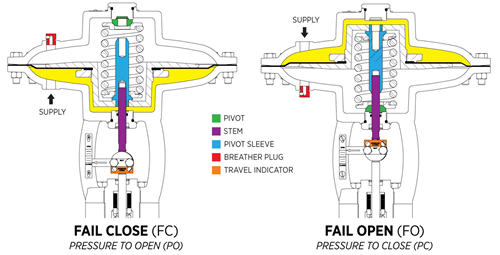
Figure 3. Fail Open vs Fail Closed Operation
Fail Open
Fail open means the relay cannot complete the circuit, so the load will not receive power. The connected device stays OFF even when it should turn ON. You will often see this problem in mechanical relays. Over time, the contacts can wear out, burn, corrode, or fail to close properly. A damaged coil or weak spring can also stop the relay from working. From a safety view, fail open is usually less unsafe since power is removed from the load. However, it can still cause downtime, equipment shutdown, or process interruption.
Fail Closed
Fail closed means the relay stays ON even when it should turn OFF. In this condition, current continues flowing to the load even after the control signal is removed. This problem is more common in solid state relays. An SSR may fail closed when its internal semiconductor becomes shorted as of overheating, overcurrent, voltage spikes, or poor heat control. Fail closed is usually more dangerous because the load may keep running unexpectedly. For example, a heater may continue heating, a motor may keep running, or a machine may keep operating when it should already stop.
How to Choose the Right Relay for Your System
Choosing the right relay depends on how your system operates, the type of load being controlled, the working environment, maintenance requirements, and overall budget.
Switching Frequency
If your system switches ON and OFF very often, a solid state relay (SSR) is usually the better choice since it has no moving parts and can handle frequent switching with less wear. Mechanical relays (EMRs) are more suitable for systems with occasional or low-frequency switching.
Environment
For harsh environments with vibration, dust, or mechanical shock, SSRs are often more reliable since there are no physical contacts that can wear or bounce. EMRs work well in normal environments but can be affected by vibration and mechanical wear gradually.
Load Type
The type of load is also required. SSRs are used for heaters, temperature control, and fast-switching applications. EMRs are usually preferred for motors, high inrush current loads, and general-purpose switching as they can handle surge current more effectively.
Maintenance
If you want lower maintenance and longer operational life, SSRs are usually the best option since there are no moving contacts to replace. EMRs may require maintenance or replacement after long-term use as the contacts wear out over time.
Budget
Mechanical relays are generally cheaper and are a practical choice for cost-sensitive systems. SSRs usually cost more, especially when heat sinks or cooling systems are required, but they can provide longer life and quieter operation in demanding applications.
SSR and Mechanical Relays Used in Real Systems
• Industrial automation: PLC machines, conveyors, packaging equipment
• HVAC systems: heaters, compressors, fans, blowers
• Motor systems: pumps, starters, small motor controls
• IoT devices: smart plugs, smart lighting, smart controllers
• Automotive systems: headlights, horns, fuel pumps, EV systems
• Home appliances: washing machines, refrigerators, ovens
• Power control systems: heaters, lighting loads, control panels
Hybrid Relay Systems (SSR + EMR Together)
A hybrid relay system combines a solid state relay (SSR) and a mechanical relay (EMR) in the same circuit to improve switching performance, reliability, and safety. This design allows the system to use the strengths of both relay types while reducing their individual limitations.
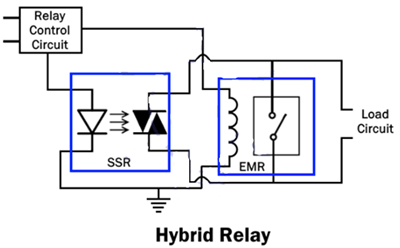
Figure 4. SSR and EMR Hybrid Relay Circuit
In many hybrid designs, the SSR performs the initial switching since it can turn ON and OFF very quickly without using physical contacts. Since there are no moving parts, the SSR helps reduce contact arcing, electrical noise, and mechanical wear during frequent switching operations.
The EMR is then used to provide physical electrical isolation after switching occurs. Mechanical contacts create a true open circuit when disconnected, which improves safety and removes the small leakage current that can still exist in SSRs when they are OFF. This makes the system safer for maintenance and sensitive equipment.
By sharing the switching process, hybrid relay systems can extend relay lifespan and improve overall reliability. The SSR reduces stress on the EMR contacts, while the EMR helps lower heat buildup and provides stronger isolation.
Common SSR and Relay Failures and Causes
Relays can fail for several reasons, especially when they operate under high electrical stress, poor cooling conditions, or incorrect load selection. Understanding these common failure causes helps improve reliability and prevent system damage.
Overheating
Overheating is one of the most common causes of relay failure, especially in solid state relays (SSRs). SSRs generate heat during operation, and without proper cooling or heat sinks, the internal semiconductor components can become damaged. High ambient temperature, poor ventilation, and continuous heavy load operation can also increase overheating risk.
Contact Welding
Contact welding mainly affects mechanical relays (EMRs). This happens when high current or sudden surge current causes the metal contacts to melt and stick together. When the contacts weld, the relay may remain permanently ON and fail to disconnect the load properly.
Arcing
Arcing occurs when electrical current jumps between relay contacts during switching. This is common in mechanical relays, especially when switching inductive loads such as motors, transformers, or solenoids. Repeated arcing damages the contact surface, increases resistance, and shortens relay lifespan.
Overcurrent
Overcurrent happens when the relay carries more current than its rated limit. Excess current can overheat SSR semiconductors or damage EMR contacts and coils. Motor startup current, short circuits, and heavy loads are causes of overcurrent failure.
Incorrect Sizing
Using a relay with the wrong voltage or current rating can cause poor performance and early failure. A relay that is too small for the application may overheat, wear out quickly, or fail during switching. Proper relay sizing is required for safe and reliable operation.
Voltage Spikes
Voltage spikes and electrical transients can damage both SSRs and EMRs. SSR semiconductor devices are especially sensitive to sudden voltage surges, while EMRs may experience insulation damage or increased contact wear. Protection devices such as snubber circuits, MOVs, and surge suppressors are used to reduce voltage spike damage.
SSR vs EMR: Which Is Better?
Neither Solid State Relays (SSRs) nor Mechanical Relays (EMRs) are universally better since each is designed for different operating conditions and system requirements. The best choice depends on switching frequency, load type, environment, maintenance needs, and cost.
SSRs are generally better for applications that require fast and frequent switching, silent operation, and long service life. They are used in industrial automation, temperature control systems, PLC-controlled equipment, and vibration-prone environments where mechanical contact wear can become a problem.
EMRs are usually better for systems with high surge current, lower switching frequency, and tighter cost requirements. They are used in motor startup circuits, automotive systems, power switching, and applications where true electrical isolation is required.
In many real industrial systems, you can use both together. An SSR may handle fast repetitive switching, while an EMR provides physical isolation and safety shutdown. The best relay is the one that matches the actual electrical and environmental conditions of the application.
 O NAS
Zadowolenie klienta za każdym razem.Wzajemne zaufanie i wspólne interesy.
O NAS
Zadowolenie klienta za każdym razem.Wzajemne zaufanie i wspólne interesy.
test funkcji.Najwyższe opłacalne produkty i najlepsza usługa to nasze wieczne zaangażowanie.
Hot Artykuł
- LM358 Dualny wzmacniacz operacyjny Kompleksowy przewodnik: Pinouts, diagramy obwodów, odpowiedniki, przydatne przykłady
- Czy CR2032 i CR2016 są wymienne?
- Zrozumienie różnic ESP32 i Analiza techniczna i ESP32-S3
- Wybór odpowiedniej baterii: Przewodnik po AG4, LR626, LR66, 177/376/377, SR626 i SR626SW
- Podstawy tranzystorów BC547: układ pinów, obwody aplikacyjne, modele alternatywne/uzupełniające
- NPN vs. PNP: Jaka jest różnica?
- ESP32 vs STM32: Który mikrokontroler jest dla Ciebie lepszy?
- Co to jest MOSFET i jak to działa?
- Przekaźnik elektryczny Podstawowy: Działanie, typy i zastosowania
- Tranzystory PNP: struktura, zasada pracy i zastosowanie
 Crystal Oscillator vs PLL Clock Synthesizer: Performance, Tradeoffs, and Applications
Często Zadawane Pytania [FAQ]
1. Why do Solid State Relays (SSRs) usually fail closed while Mechanical Relays (EMRs) often fail open?
This happens since SSRs use semiconductor devices that may short internally during overheating or voltage spikes, while EMRs rely on physical contacts that typically wear out or separate over time.
2. Why do SSRs generate more heat than Mechanical Relays?
SSRs create heat as semiconductor devices always have voltage drop during conduction. Unlike EMRs, they do not use direct metal-to-metal contact switching, so thermal management becomes required during continuous operation.
3. Why are Mechanical Relays still widely used even though SSRs have longer lifespan?
EMRs remain popular since they are cheaper, provide true physical isolation, and handle high surge current better in many motor and power applications.
4. How does switching frequency affect relay lifespan?
Frequent switching increases mechanical wear in EMRs as contacts physically move during every operation. SSRs are more suitable for high-frequency switching since they have no moving contacts.
5. Why are SSRs used in heater and temperature control systems?
Heating systems often require rapid and repetitive switching to maintain stable temperature. SSRs handle this better as they switch quickly and silently without contact wear.
6. Why can inductive loads damage relays more easily?
Inductive loads such as motors, transformers, and solenoids generate high inrush current and voltage spikes during switching, which can cause arcing, overheating, or contact damage.
7. What happens if a relay is undersized for the application?
An undersized relay may overheat, weld contacts, fail prematurely, or become unstable during switching as its voltage or current rating is lower than the actual load requirement.
8. Why do some SSR-controlled LED loads glow faintly even when switched OFF?
This usually happens since SSRs can have small leakage current even in the OFF state, allowing a tiny amount of current to pass through sensitive loads.
Gorący numer części
 C1608X7S0J475K080AC
 GCJ188R72A332KA01D
 GRM0225C1E6R9WA03L
 C1005C0G2A121K050BA
 CGA9N4X7R2J224K230KE
 GRM32EC81C476ME15L
 GRM0335C1H5R2BA01D
 08053A680JAT2A
- 08053C271JAT2A
 GRM1555C1H330FA01J
- 12105U221JAT2A
- TAP156M020CCS
- SMAJ33A
- 9DBL0651BKILF
- MT9044AP1
- MT29F64G08CBABBWP-12:B
- ATF1500A-10JC
- EPM7512BQC208-5
- TLD5045EJXUMA1
- MAX749CSA
- RT0805BRE07270RL
- 6MBI150J-120
- N282CH24
- VI-JN1-EY/F2
- AD7720BRUZ
- ADS5203IPFBR
- TPS7A6333QDRKRQ1
- MAX3232CDWR
- AD8541ARZ
- BB664-02VE7902
- ICS950952BGLFT
- ISPLSI2064E-100LTN100
- MC100EP210SFA
- NH82801GBM/SL8YB
- S34ML01G200TF100
- S5H1420X01-E0RZ
- SAF-C164CI-LM CA+
- SB5504ML
- SN761680DBTRG4
- TC74AC175F
- ZPSD301-B-90LI
- CSC0105A-01S28
- ET16312N
- M15F1G1664A-8CB
- TC9412AF
- TNETX3151PGV
- NAND98R3M0BZBB5E
- S87C752-1A28
- HG-0814